
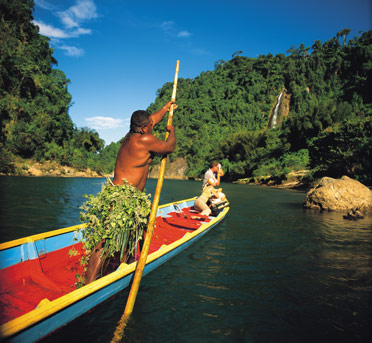
Photo: www.south-pacific.travel
Backpacker tourism as a long-haul and long term independent travel has become increasingly common over the last few decades. Once considered a marginal activity undertaken by society’s dropouts, it has gradually entered the tourism mainstream (O’Reilly, 2006). Backpacker is treated as part of a wider mainstream tourism industry in the 21st century that is becoming increasingly institutionalized.
Backpacker tourism offers a number of new insights into the Backpacker phenomenon, which often similar to mass tourism, especially if the sophistication of local backpacker infrastructure and its adaptation to meeting growing demand is considered (Spreitzhofer, 2008).
According to recent research conducted by the WYSE Travel Confederation (an organization of more than 550 members representing a global community of youth travel, student travel, cultural exchange and international education specialists), Backpacker and youth travel is the fastest growing tourist segment representing over 20% of all international visitors and generating about 109 Billion US Dollars annually (Richards, 200, in Department Trade and Industry, 2008 ). As a result of the growing significance of this market, the United Nations World Tourism Organization (UNWTO) and WYSE Travel Confederation have entered into a partnership (Cooper, 2007, in Department Trade and Industry, 2008). The aim of the partnership is to promote the industry by encouraging governments to actively support and develop youth tourism products and services.
In South Africa, this backpacker and youth niche market is important for a number of reasons. In the first place, South Africa has a growing international backpacker and youth travel market estimated at approximately 90,000 in 2006. In addition, backpacker has a tendency to be resilient and less affected by global terrorist and health hazards like 9/11 in the USA and Bird Flu for instance. This market is complementary to South Africa’s tourism mandate of halving unemployment and poverty because it offers greater opportunities for the involvement of many local communities in rural areas than do other forms of tourism. In Australia, one of South Africa’s key competitor destinations, backpackers spent a total of AUS $ 2.2 Billion in 2003 which is represents 20% of total expenditure by international visitors in the same year. A recent international visitor survey indicates that the increase in spend by backpackers in that country has pushed the value of the backpacker tourist market to AUS $3 Billion (Department Trade and Industry, 2008).
As backpacker tourism has undergone a transformation from alternative to the mainstream, the status associated with it has become more transferable. It has long been ‘‘cool’’ to travel independently, for example on the road to India in the 70s as vividly described by Tomory (1998, in O’Reilly, 2006), but it is only more recently that this coolness has been more widely acknowledged and accepted.
Backpacker has gradually moved into the margins of the mainstream as an acceptable ‘‘alternative’’ activity, assisted by knowing and unknowing analogy with the Grand Tour ideal of travel as educational, producing a more ‘‘cultured’’ individual. Ironically, now that it has entered the mainstream, backpacker is increasingly seen as ordinary and therefore less adventurous, perhaps ultimately undermining the very characteristics that have thus far made it status-enhancing.
All tourism businesses catering to backpackers need to ensure that they have friendly helpful staff who provide good service if they want to encourage positive word-of-mouth promotion. The key feature of social situations over which the industry has most control is the environmental setting, particularly hostels. There are specific considerations for hostel accommodation that should be identified. With respect to hostel design, it is evident that smaller properties are often associated with friendlier, more relaxed atmospheres. Clean and comfortable hostels also helped to create an atmosphere that was more conducive to social interaction. Extras, such as pool tables, outdoor entertainment areas, and `touches of home’ (such as duvets) can all help to eliminate a sterile impersonal feeling and create a more welcoming atmosphere. To combat the problem of being impersonal, larger hostel design might incorporate several smaller communal areas, instead of one or two large ones, to encourage smaller informal groups to form within the larger whole (Murphy, 2001).
The goal of the backpacker businesses should be to ensure that in each experience, participants receive friendly service, have fun, and are given the opportunity to meet and interact with other backpackers. The more memorable their experience, the more likely they are to pass it on; however, they must be given the opportunity to talk to others at the next hostel or on the next tour. It is also important, and perhaps encouraging, for these businesses to recognize that, although word of mouth is a common source of promotion, it is evidently only one piece of information used in the decision-making process. These tourists are influenced by other factors as well, particularly strong pre-expectations and desire to see special attractions or to have particular experiences. It appears that it takes consistently positive or negative reports to have the most influence, so the goal here should be to provide consistently high quality experiences.
While word-of-mouth promotion is the element of the marketing mix over which tourism operators have the least control, this research has highlighted ways in which they can increase the likelihood of their business being perceived as providing a positive experience, and thus of being recommended to others. The study also highlighted the fact that it is important to provide an environment and atmosphere, whether in a hostel or during tours and organized activities, which encourages social interaction, fostering the flow of information through the backpacker grapevine. Efforts by individual operators to provide quality experiences, in an environment which fosters socialinteraction, can only benefit the industry as a whole.